How to Choose an OEM E-bike Battery Manufacturer
The most expensive sourcing mistake in e-bike batteries is not paying too much. It is choosing a supplier on the strength of a low quote and a single good sample, then discovering — three production runs later — that the certifications don’t hold up, the cells aren’t what was promised, or the “manufacturer” was a trading company all along.
If you are an OEM procurement manager or sourcing engineer evaluating an OEM e-bike battery manufacturer, the decision is a due-diligence problem, not a price problem. This guide gives you a concrete way to verify a supplier before you commit: how to tell a real manufacturer from a re-labeler, which certifications are actually required, and which commercial terms to pin down up front.
Is this supplier a manufacturer or a trader?
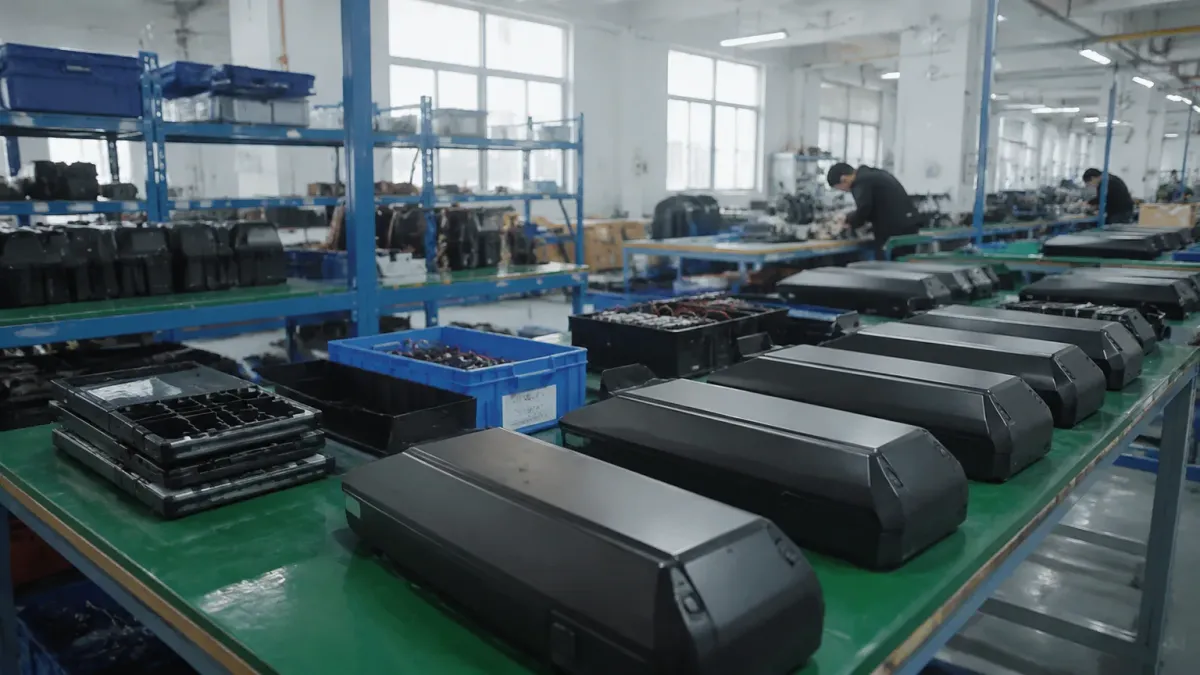
The single clearest signal that you are dealing with a real e-bike battery supplier rather than an intermediary is whether they design their own Battery Management System (BMS) and can trace their cells. A manufacturer with in-house BMS design and traceable Tier-1 cell sourcing controls the parts of the pack that actually determine safety and lifespan. A trading company re-labels packs it did not build — which means no engineering accountability and, often, opaque cell sourcing.
That distinction matters because when something goes wrong in the field, you need a partner who can open the design, not one who forwards your complaint to an unnamed factory. Three questions cut through the marketing quickly:
- Who designs the BMS — your team, or a third party?
- Which cell brand and grade, and can you share the datasheet for the cells in my quote?
- Can you show the production line that would build my pack?
A genuine manufacturer answers all three without hesitation. You can see how we answer them on our capabilities page.
Know which certifications are actually required
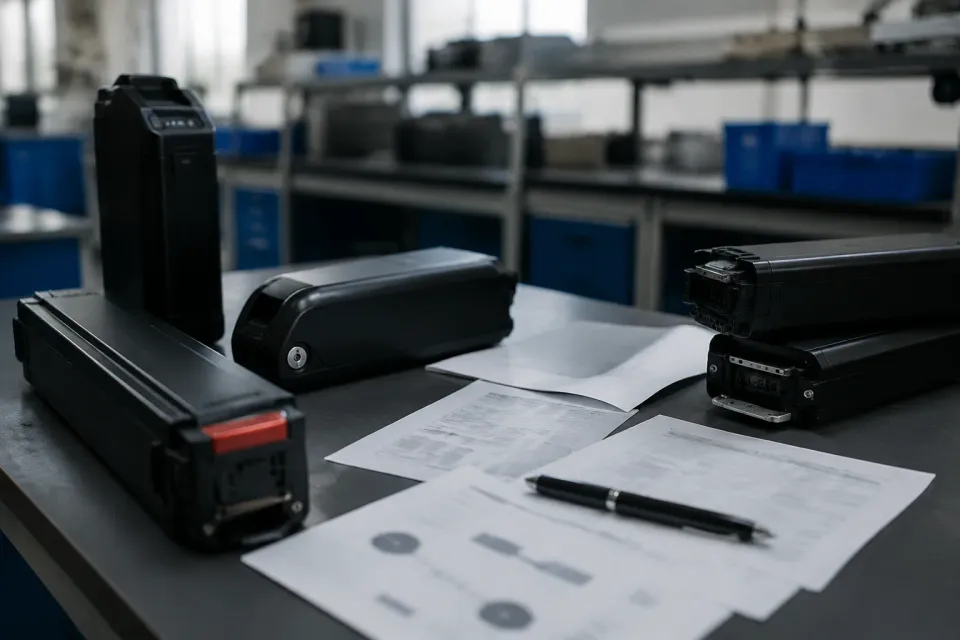
Certifications are where sourcing decisions most often go wrong, because buyers either under-specify (and get a non-compliant pack) or over-specify (and pay for marks they don’t need). For e-bike battery export, a consistent core is genuinely required; the rest is market-specific.
| Certification | What it attests | Status |
|---|---|---|
| CE (EMC + RoHS) | EU market access declaration | Required (EU) |
| UN38.3 | Lithium battery transport safety (T1–T8) | Required (global shipping) |
| IEC 62133-2 | Cell/battery safety under abuse + environmental tests | Required (safety baseline) |
| RoHS 3 | Restriction of hazardous substances | Required (EU) |
| MSDS / SDS | Material safety data for transport/handling | Required (logistics) |
| UL2271 / UL2849 | Light-EV battery / e-bike electrical system safety | Market-specific (US) |
| FCC Part 15 | Radio-frequency emissions | Optional (US, if applicable) |
| WEEE | End-of-life electronics handling | Conditional (EU, if in scope) |
Two of these deserve a closer look, because buyers routinely misunderstand them.
UN 38.3 — required, but self-managed
UN 38.3 is Chapter 38.3 of the UN Manual of Tests and Criteria. It defines up to eight tests (T.1–T.8) that qualify lithium cells and batteries for transport as Class 9 dangerous goods: T.1–T.5 run in a fixed sequence, while T.6–T.8 apply according to the cell or battery type, so not every pack runs all eight. The important nuance for procurement: there is no single UN-mandated third-party certificate for UN 38.3 — the manufacturer (and subsequent distributors) carries responsibility for compliance. But it is not a bare self-declaration: since 1 January 2020, a UN 38.3 test summary must be made available through the supply chain. So you should ask for the actual test summary — not a vague claim of compliance.
IEC 62133-2 — the safety baseline behind your CE file
IEC 62133-2 specifies safety requirements for portable sealed secondary lithium cells and batteries through electrical-abuse, mechanical-abuse, and environmental tests; under any test condition, cells must not catch fire or explode. Its European adoption, EN IEC 62133-2, is a harmonized safety standard referenced under the Low Voltage Directive. Lithium battery safety and compliance obligations are tightening in parallel under the EU Battery Regulation (2023/1542), whose product and CE-related requirements phase in from 18 August 2024 — so demonstrable cell and pack safety is becoming more central to EU market access, not less.
The practical takeaway: forged or borrowed certificates are common, so request the specific test summary and report that match the exact cell and pack you are being quoted. A supplier who can produce documents tied to your bill of materials is a different proposition from one who emails a generic PDF. Our quality page shows how compliance documentation maps to each pack, and our export certifications guide breaks down each mark in detail.
How do you verify a factory’s capability?
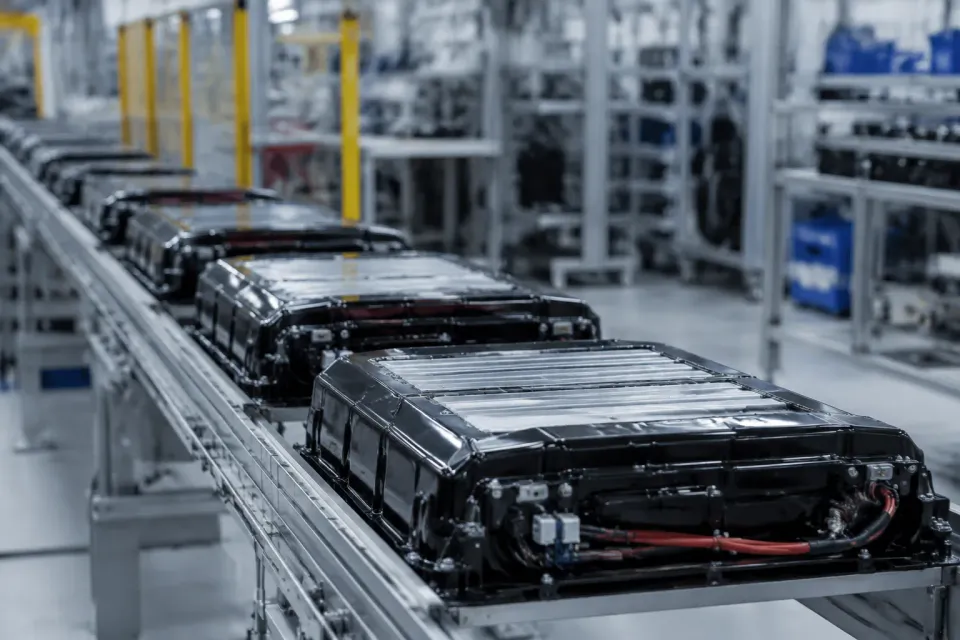
Beyond certifications, ask for evidence of how a supplier actually operates. A credible lithium battery pack supplier can show a documented production flow rather than improvising each order. Ours runs in five stages — Requirements & MOQ Confirmation, Design & Engineering, Sample Development, Mass Production, and Packaging & Shipment — and that structure is worth asking any vendor to walk you through.
Operating metrics are also fair to request from any supplier you are serious about:
- Field return rate over the product lifetime (ours is under 0.2%).
- Average length of OEM relationships, as a proxy for consistency (ours is 4.5 years).
- Total volume shipped (we are past 1M+ packs) and in-house engineering depth (30+ R&D engineers).
Treat these as questions, not as our brochure. The point is that a real manufacturer can answer them with numbers; a trader usually cannot.
Pin down commercial terms before you commit
Most disputes trace back to terms that were never made explicit. Before you sign, get clear answers on:
- MOQ — the minimum order quantity, and whether it differs for a first order.
- Sampling — lead time and cost for a functional sample. Ours is typically 5–10 working days.
- Mass-production lead time — ours is typically 2–4 weeks after sample approval.
- Private-label scope — for a private label ebike battery, confirm exactly what is customizable: labels, packaging, connectors, BMS parameters, and enclosure. Settle whether you are buying OEM or ODM at the same time, because that decides who owns the design.
A supplier who won’t quote an MOQ or a sampling timeline is telling you something. Transparency on these terms is itself a due-diligence signal.
The buyer’s due-diligence checklist
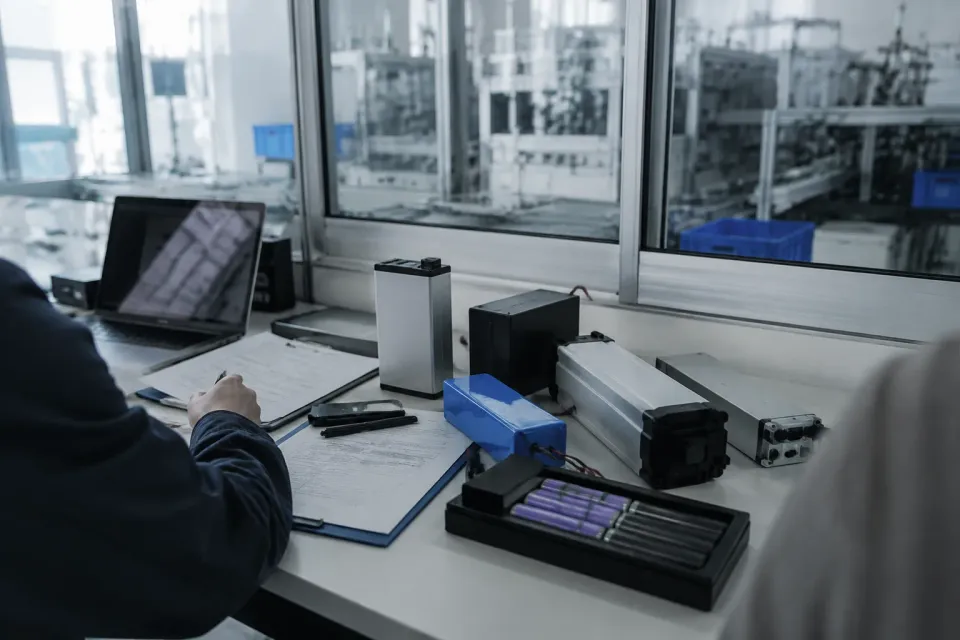
Use this as a copy-paste checklist when you compare a custom lithium-ion battery pack quote across vendors:
- Manufacturer identity: factory verified, BMS designed in-house, cell brand and datasheet disclosed.
- Compliance: CE, UN 38.3 test summary, IEC 62133-2 report, RoHS, and MSDS — each matched to the exact pack quoted.
- Quality control: a documented multi-stage process with traceability from cell to finished pack.
- Commercial: MOQ, sample lead time, mass-production lead time, and private-label scope confirmed in writing.
If a supplier clears every line, you are sourcing from a manufacturer. If they stall on more than one, keep looking.
Go deeper on two decisions
Two parts of this checklist reward a closer look:
- Customization — what an OEM program lets you actually change, and the MOQ and IP terms behind it: private label e-bike batteries, what you can customize.
- Certificate verification — how to tell a genuine test report from a borrowed or forged one: how to verify a supplier’s certificates.
Move from checklist to quote
Choosing the right OEM partner comes down to verification, not the lowest number on the first email. The vendors worth your time will welcome the questions above — and answer them with documents and data.
Our own answers to this checklist sit alongside each pack in the product catalog. If you want to put a supplier through it, send us your spec sheet and we’ll respond with a fit assessment, the matching compliance documentation, and a preliminary quote.