E-Bike Batteries for Delivery Fleets: A Buyer's Guide
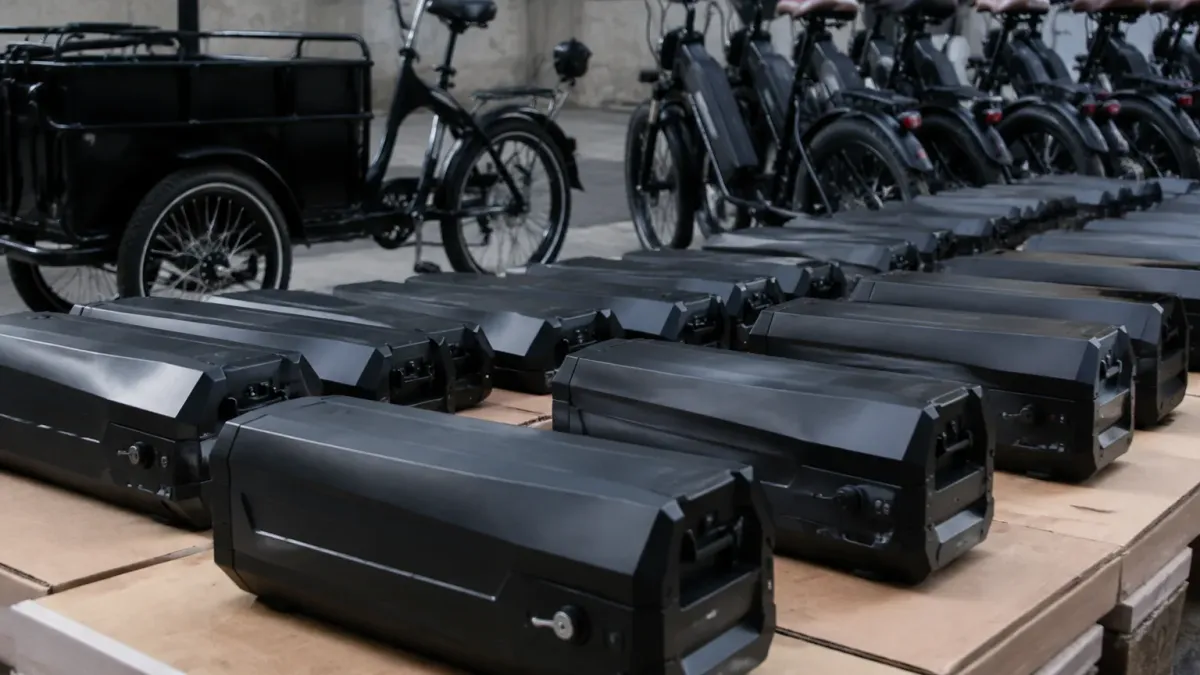
For a last-mile delivery fleet, the battery is the single biggest variable in uptime and running cost — more than the frame, more than the motor. A pack that fades early, charges too slowly between shifts, or can’t finish a route pulls a bike off the road and eats margin. Yet most buying advice treats the battery as a headline watt-hour number, which is the wrong lens for a fleet.
Three variables set fleet battery economics: which cell chemistry you run, how deep you discharge the pack on a typical day (its depth of discharge), and how aggressively you charge it between shifts. This guide is a supplier-neutral framework for those decisions. Published material on delivery batteries tends to split into two unhelpful halves — vendor pages selling one specific pack, and consumer blogs answering “how long does an e-bike battery last?” for a single rider. Neither answers what a fleet buyer actually needs to know, so that is the gap this guide fills.
Why a fleet battery is a different problem
Delivery duty cycles are far heavier than personal riding. Industry and vendor sources describe full-time delivery riders covering roughly 40–60 miles per day on unpredictable routes, stopping 20–30 times per shift and carrying loads of 30+ lb. Treat that as a typical range rather than a hard benchmark, but the direction is clear: a delivery bike sees in a week what a commuter sees in a month or more.
Fleet managers tend to ask how many years a battery will last. Wrong unit. What actually wears a pack out is cycle count, not calendar age — a delivery bike can rack up a year’s worth of commuter cycles in a month. Size the question in cycles per year under load, and the three levers below tell you what that number costs.
Cycle life is set by depth of discharge — and by chemistry
A lithium pack’s cycle life is usually defined as the number of full charge–discharge cycles it completes before capacity falls to about 70–80% of the original. How deeply you discharge each cycle has a large, and often underestimated, effect — a relationship established in the degradation literature on cycling conditions — and that effect differs by chemistry.
Approximate figures published by a battery manufacturer illustrate the pattern (treat these as illustrative vendor estimates; actual numbers depend on the cell, temperature, and current):
| Depth of Discharge | NMC (approx. cycles) | LFP / LiFePO4 (approx. cycles) |
|---|---|---|
| 80% DoD | ~400 | ~900 |
| 60% DoD | ~600 | ~1,500 |
| 40% DoD | ~1,000 | ~3,000 |
| 20% DoD | ~2,000 | ~9,000 |
The practical takeaway for a fleet: sizing the pack so a typical daily route uses a shallower slice of its capacity buys disproportionately more cycles. A bike that finishes the day at 40% DoD instead of 80% can more than double the pack’s service life. Spec-ing a little more capacity than the route strictly needs is often cheaper over the fleet’s life than replacing packs early. For the underlying cell-format and specification detail, see our capabilities overview and the 18650 vs 21700 cell guide; this guide stays on the fleet-economics layer.
NMC vs LFP for a delivery fleet
The table above hints at the core chemistry trade-off, and it deserves its own decision.
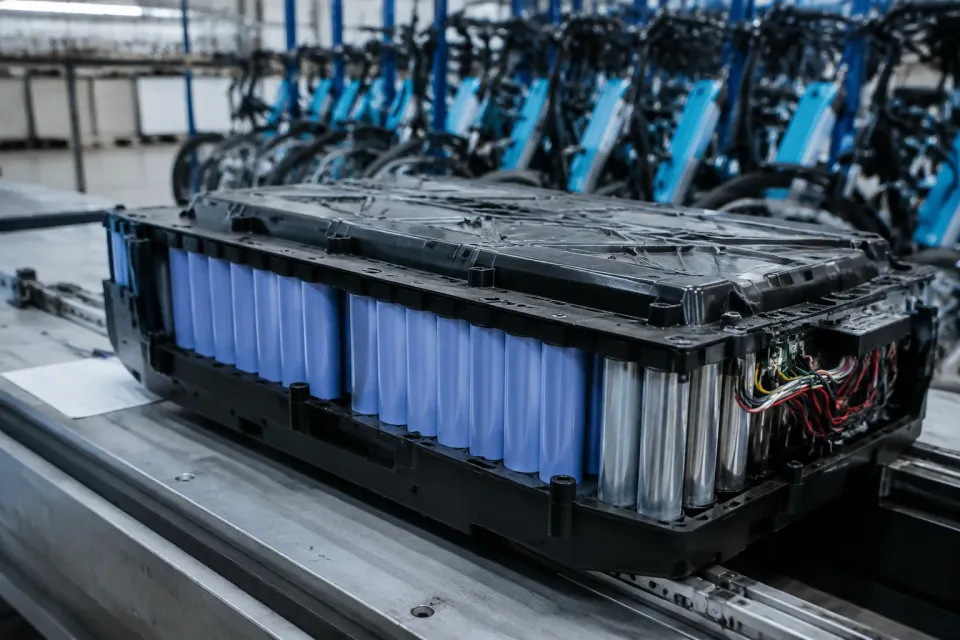
LiFePO4 (LFP) batteries are the longevity champions — commonly cited at 2,000 to 10,000 cycles depending on how they are used — and they bring strong thermal stability. NMC (nickel-manganese-cobalt) gives up some cycle life but offers higher energy density, meaning more range per kilogram of pack. Neither is simply “better.” The delivery duty cycle decides:
- A high-utilization fleet running multiple shifts a day, where packs cycle hard and total cost per mile dominates, leans LFP — the extra cycles pay back directly.
- A fleet where riders need maximum range from the lightest possible pack, and packs are replaced or rotated before deep wear, can justify NMC for the energy density.
At Lizo Power we build packs in both chemistries precisely because the right answer is fleet-specific rather than universal. For the head-to-head on the chemistries themselves, see our NMC vs LiFePO4 guide.
Fast charging: turnaround versus cycle life
Shift-based delivery makes fast charging tempting — get a pack back on the road in twenty minutes instead of two hours. But there is a real, measurable cost. Peer-reviewed and industry work is consistent: higher charge C-rates accelerate capacity fade, and the relationship is nonlinear — cycle life drops sharply as the charge rate climbs, with charging above roughly 3C accelerating degradation markedly. Fast charging, in short, inevitably trades cycle life for turnaround time.
For a fleet that means the charging regime is a design decision, not an afterthought:
- If you must turn packs around fast, plan for the shorter pack life that aggressive charging brings, and budget replacement accordingly.
- Often the cheaper path is more packs, gentler charging — a pool of spares charged at a moderate rate keeps bikes moving without hammering every cell at high C-rate.
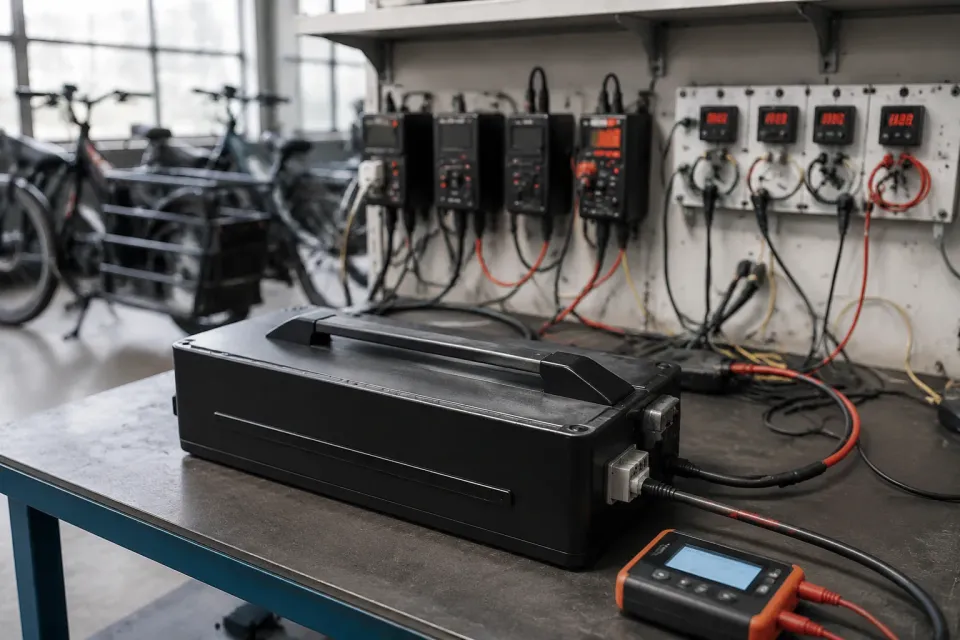
Depot charging also carries safety and standards obligations. Those belong to the compliance layer, not this one — see our import and compliance overview rather than re-deriving standards here.
Swappable and standardized packs — the downtime lever
The most direct answer to fleet downtime is not a faster charger; it is not charging the bike at all. Battery swapping — exchanging a depleted pack for a charged one, sometimes offered as a Battery-as-a-Service model — reduces fleet downtime and upfront vehicle cost and removes range anxiety, which is exactly why it is being adopted at delivery scale.
The trend has institutional backing: New York City’s Department of Transportation is installing a citywide e-bike battery-swapping network aimed at delivery workers, a signal that swap infrastructure is becoming part of the delivery landscape rather than a fringe experiment.
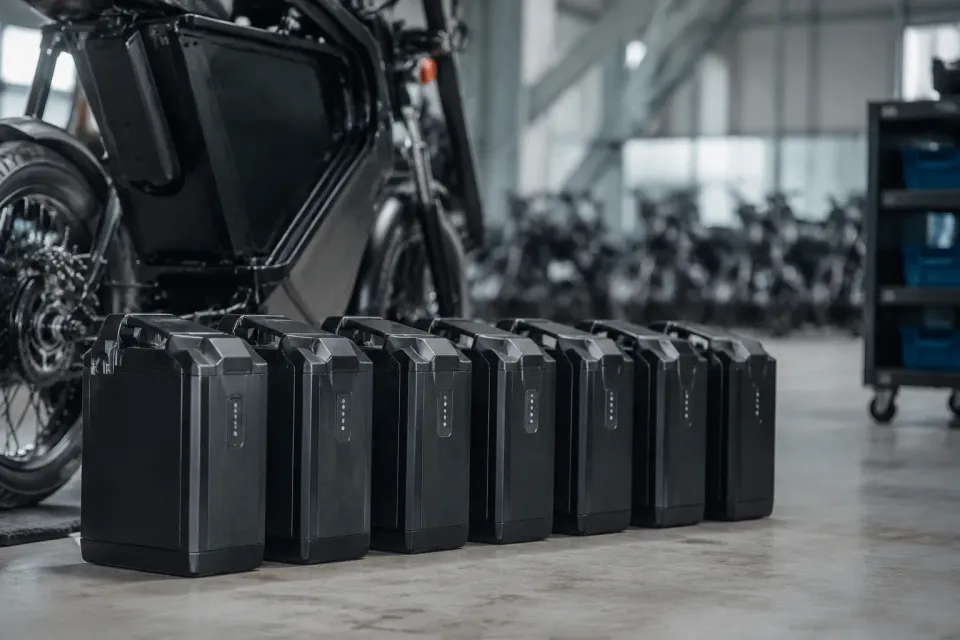
Swapping pays off most clearly for multi-shift, high-utilization fleets, and it depends on one thing above all: standardization. A single pack form factor and a single charger across the whole fleet is what makes swapping, spares pooling, and depot logistics work. That is a spec decision to make up front — a standardized, swappable pack with consistent BMS and telemetry is far easier to operate at fleet scale than a mix of one-off designs. It is one of the capabilities we design for at the OEM level.
A fleet battery selection checklist
Pulling the levers together, here is what to pin down before you commit — no new numbers, just the decisions this guide has walked through:
- Daily energy budget / range: size to the real route (with headroom), not the brochure figure.
- Chemistry by duty cycle: LFP for cycle-heavy multi-shift use; NMC where range-per-kg matters most.
- DoD headroom: spec enough capacity that typical days run shallow — it buys cycles cheaply.
- Charge regime and spares: decide fast-turnaround-plus-shorter-life versus more-packs-and-gentler-charging.
- BMS and telemetry: fleet-grade monitoring so you catch weak packs before they strand a bike.
- Warranty and replacement logistics: how fast can a dead pack be replaced, and who carries the spares?
- Swappable vs fixed: standardize the pack and charger if you run multiple shifts.
On total cost of ownership, the honest framing is qualitative. Cost per mile is set by how often packs are replaced (cycle life) plus the cost of any downtime, and both are driven by the chemistry, DoD, and charging choices above — not by the sticker price of the pack. A cheaper pack that lasts half as many cycles is rarely cheaper per mile.
Where to go next
If you are moving from “how do I choose a fleet battery” to “who do I buy it from,” the next step is supplier diligence — see our guide on choosing an OEM e-bike battery manufacturer. If you are importing, the import and compliance overview and the US compliance guide cover the regulatory and shipping side. Running a different demanding duty cycle? See our cargo bike battery guide for loaded-route spec, and our performance eMTB battery guide for discharge-rate and thermal design under sustained high-power riding.
Fleet packs are built on our OEM pack platform. When you are ready to spec them, talk to our team — tell us your routes, shift pattern, and volume, and we will help you match chemistry, capacity, and charging to your duty cycle.
Frequently asked questions
How long do e-bike batteries last for delivery use? In cycles, not just years. A pack lasts until capacity drops to about 70–80% of original, and delivery duty cycles reach that point far faster than personal use because riders commonly cover 40–60 miles a day. Running shallower depth of discharge and gentler charging extends the cycle count significantly.
Which battery chemistry is best for a delivery fleet? It depends on the duty cycle. LFP (LiFePO4) offers much longer cycle life and better thermal stability, which suits cycle-heavy, multi-shift fleets. NMC offers higher energy density (more range per kg) and can suit fleets that prioritize range and rotate packs before deep wear.
Are swappable batteries worth it for a delivery fleet? For multi-shift, high-utilization fleets, usually yes — swapping cuts downtime and upfront cost and removes range anxiety. It only works if the pack and charger are standardized across the fleet, so decide it up front.
How much range does a delivery e-bike need? Enough to cover a full shift with headroom. Full-time delivery routes commonly run 40–60 miles a day, so size the pack above that so typical days use a shallower depth of discharge — which also extends pack life.